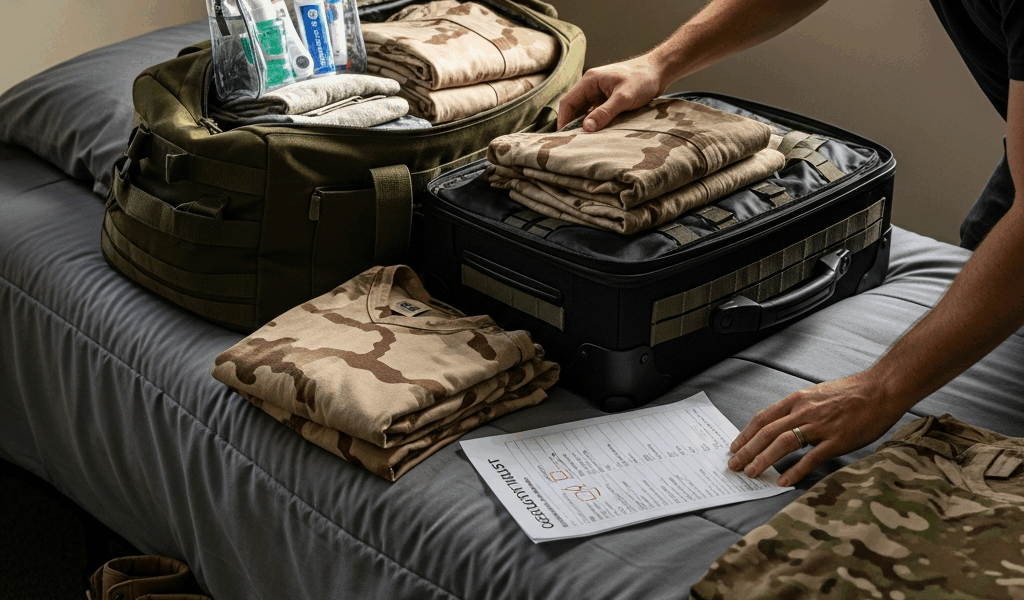
TDY Packing List — What to Bring for 2 Weeks on Orders
TDY packing has gotten complicated with all the conflicting advice flying around. As someone who has packed for roughly forty temporary duty assignments across three continents, I learned everything there is to know about what actually makes it into the bag — and what gets left behind at a hotel in San Antonio because I forgot it existed.
This isn’t a generic checklist pulled from a regulation. I’ve forgotten critical items. Overpacked like I was relocating permanently. Once showed up at Lackland with no CAC reader and burned two hours troubleshooting DTS entries on a borrowed laptop from a guy in the neighboring room who looked equally miserable. Don’t make my mistake.
The Items People Always Forget
Probably should have opened with this section, honestly. The things that slip through aren’t the obvious ones. You’ll remember socks. You’ll forget the actual items your entire trip depends on.
Documents and Travel Authority
Your orders. Physical copies. Two of them — one in the carry-on, one buried in the checked bag. I’ve personally watched someone get turned away at a rental car counter because they had a phone photo of their orders. The agent didn’t negotiate. Print them.
Your government travel card activation confirmation. Separate from the card itself. Print this too. If your first transaction kicks back an error at the hotel desk at 11 PM, you’ll need proof the card is active — and your orderly room won’t answer until 0730.
A copy of your TDY authorization memo or leave request. Hotels on government rates sometimes ask for it during check-in. This apparently catches people off guard every single time, despite happening constantly.
Your CAC Reader
But what is a TDY without DTS access? In essence, it’s a logistical nightmare. But it’s much more than inconvenient — it can delay your reimbursement by weeks if you can’t submit vouchers on time.
DTS doesn’t work without a CAC reader. Your laptop has two USB ports. Only one will fit your reader. The military-issued reader is bulky but reliable. I carry a SCM Microsystems reader — roughly the size of a car key fob, $28 on Amazon back in 2019, still works fine. Bring a second one if you have it. Not for yourself. Someone at your TDY location will need to borrow it. They always do.
Power and Connectivity
Phone charger. Laptop charger. A 10-foot USB-C cable at minimum. Most hotel outlets were clearly designed for 1970s lamp plugs, not humans who need to charge three devices from the bed. The long cable solves this problem without any drama.
If your duty station has unreliable WiFi — and most do — bring a mobile hotspot. Verizon’s Jetpack runs around $70. I’ve used the same one for eight years across more assignments than I can count. It earns its bag space every single time.
The Belt
Your OCP belt. Seems almost dumb to list it separately. Most people don’t pack it — they assume they’ll wear the same one the whole TDY or borrow one from a locker that doesn’t belong to them. Bring yours. This is non-negotiable.
Uniform and PT Gear
The uniform math shifts depending on your TDY location’s laundry situation. Base laundry facility nearby? Fewer sets required. Temporary location with no reliable access? Pack for redundancy.
The Math on Uniform Quantities
A two-week TDY breaks down to ten duty days and four weekend days. Wear each OCP set twice if you’re doing laundry mid-week. That’s five sets minimum.
I pack six. The extra set covers spills, extended duty, and that random Friday when PT somehow wrecks everything you’re wearing. I’ve never once regretted the sixth set. I’ve absolutely regretted not having it — specifically on a Thursday in Fort Huachuca when someone knocked an entire cup of coffee across my uniform at 0645.
Bring two pairs of black socks specifically for dress uniform situations. Eight pairs of regular socks total. Laundry happens midweek — plan for it taking two full days to cycle through.
PT Gear Requirements
Your full unit PT uniform — shorts or long pants depending on climate. PT socks are different from regular socks and get destroyed in laundry faster than you’d expect. Bring four pairs.
Running shoes and cross-training shoes both. Your unit won’t care about brand, but rotating footwear matters — wet shoes don’t dry overnight in humid climates, and you’ll be wearing them again at 0530 regardless.
Reflective belt. Every base, every location, no exceptions. Pack it near the top.
Laundry Strategy
Find the laundry facility on day one. Not day two — day one. Confirm hours, confirm payment method — quarters, card access, or pre-paid vouchers. That determines your entire clean-clothes timeline for the TDY.
Military laundry facilities dry uniforms in about 45 minutes. Civilian hotel laundry runs closer to two hours. That gap matters significantly when you need to make a 0600 formation.
Never pack exactly seven days of underwear for a two-week TDY. You’ll miss laundry day. You’ll have an unexpected extra duty day. Something will spill. Pack ten days’ worth and do laundry around day seven.
Electronics and Admin
Your laptop isn’t optional — DTS requires it, full stop. I’ve used government-issued machines and personal laptops both. The government laptops are slower, run outdated software, and arrive preloaded with six security programs fighting each other. Bring your personal laptop if your orders allow it.
The DTS Setup
CAC reader plugged in, tested, confirmed working before you leave home station. Don’t discover it’s broken at 9 PM in a hotel room when you’re trying to upload dinner receipts from three hours ago.
Two power banks minimum — one USB-C, one standard USB. Your phone will die during travel. Your power bank will die if you charge your phone twice from it. That’s just the math. Carry two.
A portable monitor. This sounds excessive until you’re filling out a seven-page expense report on a 13-inch laptop screen in a hotel room with bad overhead lighting. A folding portable monitor runs about $80 and takes up four inches of luggage space. That’s what makes this item endearing to us TDY veterans — small investment, enormous quality of life improvement.
WiFi and Connectivity
Government WiFi access credentials saved on both your phone and laptop before departure. Most bases allow pre-registration or auto-connect — do this at home station, not in the parking lot of your TDY location.
Hotspot device with an active data plan. Non-negotiable if your base WiFi requires CAC authentication. Sometimes the reader doesn’t cooperate. Sometimes the network drops entirely. You need a fallback that doesn’t require a help desk ticket.
A car charger adapter for your phone. Your rental car might have USB ports from 2015 that charge at approximately the speed of continental drift. Bring your own adapter and skip the frustration.
Civilian Clothes and Comfort Items
After duty hours, you’re not military. You’re a human being in a temporary location trying to decompress. Dress accordingly and don’t overthink it.
Off-Duty Wardrobe
Three pairs of jeans. Two casual shirts. One slightly nicer shirt for dinner situations that call for it. One light jacket. Civilian underwear and socks in excess of your uniform calculations — these are separate counts.
One pair of casual shoes that aren’t your running shoes. I pack a pair of Merrell hiking shoes — they handle everything from base town restaurants to unexpected walks through unfamiliar areas without looking ridiculous in either context.
Shorts appropriate to your location’s climate. Summer in Mississippi means you need them. Winter in Alaska means you don’t. This seems obvious until someone packs wrong and suffers for fourteen days.
Gym and Recreation Gear
Gym clothes beyond your PT uniform — shorts and a shirt that aren’t official issue. Most TDY locations have a fitness center on base or within reasonable distance. One pair of shower shoes.
Full-size toiletries. Full-size deodorant. Full-size shampoo. Travel sizes run out on day nine of a fourteen-day TDY, and you’ll spend twenty minutes in a gas station trying to find something acceptable. Pack the actual bottles.
Comfort Items From Home
Your pillow. This seems indulgent until night three on a hotel pillow that feels like it was filled with compressed regret. I travel with a Coop Home Goods pillow — packs down to roughly 40 percent of its full size, fits without drama, and has salvaged more TDY trips than I can count. Started bringing it in 2018 and I won’t go back.
Something for evenings. A book, a tablet with downloaded shows, a portable gaming device — whatever keeps you occupied at 8 PM when the duty day is done and the hotel room walls start closing in. Boredom is underrated as a morale problem.
Small photos of family, pets, or home — laminated, wallet-sized. Sounds sentimental. It works anyway.
The Carry-On vs Checked Bag Decision
Your military travel allowance typically covers one carry-on and one checked bag. Some assignments allow two checked bags. Check your specific orders — don’t assume.
What Goes Where
Carry-on: Orders, government travel card, CAC reader, phone chargers, laptop, medications, glasses, one change of uniform. If your flight gets delayed or your bags get lost — and bags get lost — these items keep the mission functional.
Checked bag: Everything else. Uniforms, PT gear, civilian clothes, comfort items, full-size toiletries. Pack it heavier and fuller than the carry-on without guilt.
Packing Strategy
Roll your uniforms instead of folding them. Saves space, reduces wrinkles, and makes unpacking faster. I use compression bags for bulky items like PT shorts and jackets — volume drops by roughly half, which frees up meaningful space.
If your TDY runs longer than two weeks or laundry access is genuinely unreliable, ship a second box of uniforms ahead. Coordinate with your sponsor or billeting office for the receiving address. Ship USPS to the duty location address — not the base’s general mailing address.
Most commercial carriers waive checked bag fees on military orders. Confirm this before booking. Budget carriers apparently charge $35 per bag regardless of military status, and they are not sympathetic about it at the counter.
The Weight Reality
Most airlines cap checked bags at 50 pounds. Most military members arrive at check-in with exactly 48.5 pounds and a look of cautious optimism. Bring a small luggage scale — they cost $12 and eliminate that specific kind of stress entirely.
Your carry-on has weight limits too, usually around 40 pounds. A laptop bag fully loaded with chargers, CAC reader, power banks, and a portable monitor lands somewhere between 18 and 22 pounds. Leave room for documents and whatever you pick up during the assignment.
TDY packing gets easier after you’ve done it five or six times. Until then — use this list, pack the day before departure, and do a final check specifically for orders, CAC reader, and chargers. Those three things unlock the rest of the trip. Everything else is just weight.



Leave a Reply