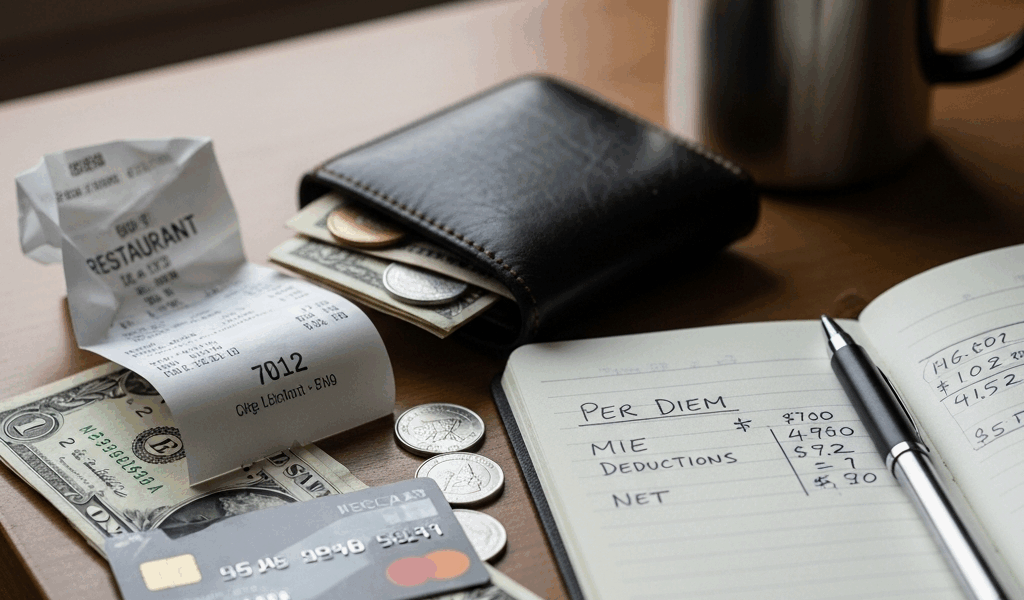
MIE Per Diem Explained — What You Keep and What Gets Deducted
MIE per diem has gotten complicated with all the conflicting information flying around — half of it vague, most of it written for finance clerks, none of it useful when you’re sitting at your kitchen table squinting at TDY orders the night before a flight. As someone who learned this stuff the hard way — first TDY out of Fort Campbell, three days in San Antonio, absolutely convinced I’d pocket the full daily rate — I learned everything there is to know about how military per diem actually works. I did not pocket the full daily rate. The finance office walked me through the math afterward, and honestly it was one of those moments where the rules weren’t the problem. Nobody had just said them plainly. This is that plain version.
But what is MIE? In essence, it’s the meals and incidental expenses portion of your daily per diem — separate from lodging, separate from mileage, separate from everything else on your travel voucher. But it’s much more than that. It’s a structured system with specific deduction triggers, and if you don’t know those triggers before you leave, the voucher math will surprise you on the back end. The rates come from GSA for CONUS travel. The military-specific rules — what happens when a DFAC is nearby, what happens at a catered conference — come from the Joint Travel Regulations. That’s the gap most pre-deployment briefings never fill.
What MIE Actually Covers
MIE bundles two things into one daily rate: meals and incidentals. People forget the incidentals piece constantly — then get confused when their tip claim goes sideways on a voucher.
The meals portion represents three standard daily meals. Breakfast, lunch, dinner. Not what you actually ordered at the Denny’s off the interstate — just three abstract daily meal slots that become the basis for calculating what you’re owed. The incidentals portion covers tips to hotel staff specifically. The housekeeper. The bellhop who muscled your duffel through the lobby. That’s a narrow definition, and we’ll come back to it.
The standard CONUS MIE rate in FY2026 sits at $68 per day. That’s the baseline most domestic TDY destinations use, and it’s the number I’ll run with throughout this article to keep the math clean. Higher cost-of-living cities — New York, San Francisco, D.C. — operate at elevated tiers. But $68 is what you’ll see on most orders, and it’s a good anchor.
Here’s what catches first-timers: MIE isn’t a general stipend you spend however you want. Each meal carries an assigned dollar value, and when someone else furnishes that meal — a conference organizer, a government dining facility, a unit function — that value comes straight off your daily MIE. No double-dipping. The government won’t reimburse a lunch you didn’t pay for. Simple enough in theory, consistently surprising in practice.
The Meal Breakdown by Tier
Probably should have opened with this section, honestly. The per-meal breakdown is the foundation for everything that follows — every deduction, every rate adjustment, every voucher dispute — and it makes more sense to know it upfront.
GSA divides the $68 CONUS MIE rate into four line items:
- Breakfast — $13
- Lunch — $15
- Dinner — $31
- Incidentals — $9
$13 + $15 + $31 + $9 = $68. It checks out.
Dinner getting almost double everything else isn’t an accident. GSA’s methodology assumes dinner is your heaviest expense on the road — a reasonable assumption for most travelers — and the allocation reflects that. Breakfast pulls the smallest slice. If you personally skip breakfast and blow $40 on a lunch platter somewhere, the math doesn’t adjust for your preferences. The deduction is based on the assigned slot value, not your actual receipt.
Higher-cost locations scale all four line items up proportionally. The structure — breakfast, lunch, dinner, incidentals — stays identical across every tier. Knowing these specific numbers matters because the moment a meal is furnished by someone else, that exact dollar amount disappears from your daily rate. Knowing the numbers before you swipe your card is how you avoid budget surprises mid-TDY.
What Happens When Meals Are Provided
This is the section that catches people off guard. Especially at conferences — and I say that from firsthand experience standing at a hotel buffet line realizing I probably should have checked the agenda more carefully.
The Conference Scenario
You’re at a four-day professional military education conference. Registration covers a catered lunch each day. That lunch is considered “furnished” — the government, or a government-sponsored event, put food in front of you — so the $15 lunch deduction pulls from your daily MIE automatically. You get the catered chicken piccata, and you lose the $15. There’s no reimbursement stacked on top of a free meal.
On a standard $68 day, losing lunch leaves you with $53 for the rest of the day. Across four conference days, that’s $60 less than a traveler who didn’t read the agenda might have expected. Not devastating — but real money, especially if the city is expensive and you’re covering dinner out of pocket every night.
Same logic applies to hotel breakfasts bundled into the room package. Same logic applies to unit farewell dinners held during TDY. Meals furnished are meals deducted. The source doesn’t matter much — the outcome does.
Government Meal Rate — GMR
Here’s where things get specifically military. If a government dining facility — DFAC, galley, chow hall, take your pick — is available at your TDY location, different rules apply. You may fall under the Government Meal Rate (GMR) instead of the standard MIE allocation.
The GMR is a fixed, low daily rate — roughly $14.85 for all three meals combined, though that number gets updated periodically and your orders or local finance office will have the current figure. The logic: the government has subsidized food available to you, so reimbursement drops to reflect what it actually costs to eat there. $14.85 total. Not per meal.
GMR applies when a DFAC is available and your commanding officer hasn’t authorized a higher rate. “Available” has a specific JTR definition — distance and operational factors matter. A DFAC existing somewhere on a large installation doesn’t automatically trigger GMR if it’s not reasonably accessible to you. But if you’re TDYing to a major post and there’s a chow hall nearby, assume GMR is in play until your orders or finance says otherwise. Don’t make my mistake of assuming the standard rate applies by default.
Proportional Meal Rate — PMR
The Proportional Meal Rate (PMR) is the middle-ground calculation — used when some meals are furnished but not all. Rather than pulling a flat dollar deduction per meal, PMR runs a formula accounting for which specific meals were provided and adjusts your daily MIE accordingly.
The formula takes total MIE, subtracts the $9 incidentals piece, then applies a percentage based on furnished meals. The first time you see it on a travel voucher it looks like a spreadsheet error. It’s not. Your finance office handles the calculation — but knowing PMR exists, and that it’s distinct from a straightforward per-meal deduction, means you won’t dispute a voucher that’s actually done correctly.
Bottom line: know what meals are being provided before you leave. Check the conference agenda the week before travel. Ask your sponsor at the gaining unit whether a DFAC is available and whether GMR applies. Surprises here come directly out of your pocket.
First and Last Day Rule
On travel days — departure from home station and return — you receive 75% of the applicable MIE rate. Not 100%. There’s no sliding scale. No adjustment for whether your flight left at 0500 or 2100. The rule is fixed at 75%, period.
On a $68 MIE day, 75% is $51. That’s the ceiling for day one and the final day of any TDY, regardless of travel timing. I built my first TDY budget around five full-rate days. Two of those days paid at $51. The math didn’t work the way I’d planned.
Here’s the practical rundown on a standard five-day TDY:
- Day 1 (travel): $51
- Days 2–4 (full days): $68 × 3 = $204
- Day 5 (travel): $51
- Total MIE: $306
Not $340. A $34 difference — which matters more than it sounds when you’re TDYing somewhere expensive and that MIE is covering actual meals, not just sitting in your account as a bonus.
The 75% rule applies differently to lodging — that’s a separate conversation — but for MIE specifically, it’s clean: first day, last day, 75%. Everything in between, 100%.
Incidentals — What Counts and What Does Not
The $9 incidentals line is probably the most misunderstood piece of the entire MIE structure. People treat it as a general miscellaneous fund. It isn’t — not even close.
Under the JTR, incidentals cover tips to hotel staff who provide services. Specifically:
- Tip to the bellhop who carried your bags up three flights — covered
- Tip left for housekeeping on the nightstand — covered
- Tip to the doorman who flagged down your cab — covered
Short list. That’s intentional.
What incidentals do not cover:
- Laundry or dry cleaning
- Personal phone calls
- Internet access fees (these may be separately reimbursable depending on orders)
- Restaurant tips — those come out of your meal allowance
- Minibar charges, room service upgrades, anything recreational
Laundry trips people up most — especially on longer TDYs where it becomes a genuine expense rather than a theoretical one. Extended TDY actually authorizes laundry reimbursement as a separate line item, not pulled from your $9/day incidentals. That’s the good news. The bad news: you have to know to submit it that way.
Stumped by this on a two-week TDY to Fort Huachuca — I submitted laundry under incidentals on my first voucher and finance kicked it back immediately. Resubmitted with laundry as a separate authorized expense, which my orders did cover for TDYs over 14 days, and it processed fine. Read the orders carefully. If anything’s unclear, call finance before you travel — not after.
Putting It Together Before Your Next TDY
MIE per diem for military travel isn’t complicated once the structure makes sense. The $68 standard CONUS rate breaks into four buckets. Travel days pay at 75%. Furnished meals — conference catering, DFAC access, unit events — get deducted by slot. Government Meal Rate applies when government dining is available. Proportional Meal Rate handles partial-meal situations. Incidentals cover hotel staff tips and nothing outside that.
While you won’t need to memorize the JTR cover to cover, you will need a handful of things confirmed before you leave. First, you should check the MIE tier for your TDY location on the GSA website — at least if you want the math to be accurate before you arrive. Second, scan your conference or training schedule for any provided meals and subtract those values from your daily estimate. Third, confirm with your unit’s S4 or budget office whether GMR applies at the gaining installation.
That’s what makes this system manageable for us — it’s consistent once you know the rules. The traveler who does those three things before departure doesn’t get blindsided by their voucher. That’s the whole goal here. Know the structure, budget against reality, file clean. Your finance office will notice the difference, and so will your bank account.

Leave a Reply