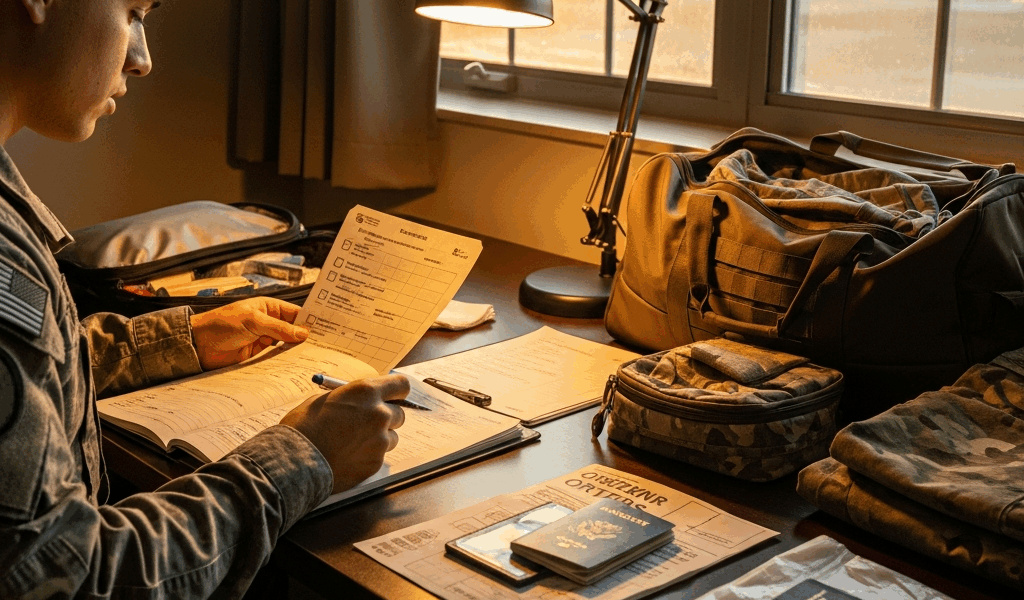
First TDY Checklist — Everything You Need to Know Before You Go
TDY prep has gotten complicated with all the conflicting advice flying around. Ask three veterans how to handle your first Temporary Duty assignment and you’ll get four different answers, two of them wrong.
As someone who showed up to their first TDY missing half their paperwork — GTC card still sitting in the mailroom back at home station, orders not printed, finance office completely out of the loop — I learned everything there is to know about doing this the hard way. That experience taught me to build a system. Today, I will share it all with you.
This isn’t theory. This is the checklist I wish someone had stuffed in my hands before I stood at a Denver hotel desk looking completely lost at 11 p.m.
Before You Get Orders — What to Ask Your Supervisor
The worst time to ask clarifying questions is at the airport. So ask them now.
Your supervisor knows more than you think — and less than you assume. The trick is finding the right people and hitting them with the right questions before the paperwork starts moving and everyone suddenly becomes hard to reach.
Duration and Location
How many days are we actually talking? A week? Six weeks? This changes everything. What you pack. What you need from finance. How your family manages while you’re gone. I’ve watched people show up for what they believed was a two-week assignment and get surprised by six. That confusion cost them — emotionally, financially, practically.
Know the exact city. Know whether you’re staying on a military installation or in commercial lodging. Know if a hotel is already booked or if that’s on you. These aren’t small details — they affect your per diem calculations and your entire packing strategy.
Reporting Instructions and Points of Contact
Where do you physically go when you land? What time do you report? Who’s your POC at the destination — name, rank, phone number, email? Write it down in your phone and on actual paper. If you’re flying in at 10 p.m. with no idea who to call or where to show up, you’ll regret skipping this conversation. I regretted skipping it.
Duty Uniform Requirements
This determines your entire packing list, honestly. Some TDYs require dress uniforms every single day. Others are basically PT gear from morning until close. Ask whether you’re presenting to senior leadership. Ask whether the facility has restrictions on certain uniforms. And ask about the climate — packing for Anchorage in February is a completely different project than packing for Phoenix in July. Don’t make my mistake and assume.
Admin Prep — 2 Weeks Before Departure
Probably should have opened with this section, honestly. The paperwork is where most first-timers completely fall apart.
DTS Authorization
But what is DTS? In essence, it’s the Defense Travel System — the government’s platform for authorizing and reimbursing travel. But it’s much more than that. Without DTS approval, you can’t book travel. Without a submitted DTS report afterward, you don’t get reimbursed. It’s not optional and it’s not forgiving.
Your supervisor submits the travel authorization. From there it goes to whoever holds signature authority — your commander, their deputy, someone. You need to follow up. Not aggressively, but consistently. I spent nearly three hours on hold with my travel office once because my DTS authorization had been sitting in an approval queue, unsigned, for five days while I assumed everything was fine.
Two weeks out is when you catch these delays. Not two days out. Check the status yourself if you have access. If you don’t, ask your supervisor for confirmation. A screenshot works.
GTC Activation and Limit Increase
Your Government Travel Card — the GTC — is your primary payment method during TDY. Lodging, meals, transportation. The government structures it this way for audit and reconciliation purposes. It’s not a backup card. It’s the card.
If you don’t have one yet, apply immediately. Processing takes weeks, sometimes longer. If you have one but haven’t touched it in a while, it might be sitting in restricted status — call your card issuer, usually Citibank, and confirm it’s active. Then ask about your spending limit. A month-long TDY in San Francisco will burn through a $7,500 default limit faster than you’d expect. Request a temporary increase. That process takes a few business days. I’ve personally watched someone hit their card ceiling mid-trip, unable to book another night at the hotel because nobody checked this ahead of time. Don’t make my mistake.
Orders — Physical and Digital Copies
You need your orders everywhere and in every format. Three physical copies at minimum. PDFs saved to your phone, your laptop, and your email. That’s not excessive — that’s baseline.
I showed up to a hotel in Denver once with zero printed copies, fully convinced my military ID would handle everything. It didn’t. The desk agent needed to see actual orders before assigning my room. Twenty minutes of standing at the counter while a line formed behind me — entirely preventable. Print the orders.
Finance Prep — Understanding Your Pay During TDY
This is where confusion gets expensive. Real fast.
Per Diem Rates
Per diem is your daily allowance covering meals and incidentals. It varies by location — you might see $69 per day in rural South Carolina and $78 in Charlotte. Rates are set by the Joint Travel Regulations and updated on a regular schedule.
Look up your specific location’s rate on the Federal Travel Regulation website before you leave. Know that number. It tells you what you can reasonably spend on food and what’s coming out of your own pocket if you go over.
Here’s the part nobody explains clearly: per diem covers food and small incidentals. That’s it. Spend more than the rate — that’s on you. Spend less, say because you’re eating in the chow hall most days — you still collect the full per diem. Keep your receipts anyway. Finance will ask for them during reconciliation, and meals get calculated differently depending on whether you’re in government lodging versus commercial.
Travel Advance Option
Most finance offices will cut you a travel advance — money deposited into your bank account before departure to cover anticipated TDY expenses. Request it at least two weeks out. Processing takes time, and landing at your destination without funds because you missed the deadline is a rough way to start a trip.
Pay Continues Normally
Your regular paycheck doesn’t pause for TDY. You get paid exactly as you normally would. Per diem and any approved travel advance are additions on top of that — not replacements. Your rent, your car payment, your subscriptions — everything rolls forward on its normal schedule. Budget accordingly before you leave, not after you’re already there.
Family Prep — If Applicable
Military families handle TDY differently depending on duration, situation, and how old the kids are. There’s no single formula. But a few things are worth doing regardless.
Power of Attorney
A limited power of attorney lets your spouse handle emergency medical decisions, banking issues, or anything else requiring your signature while you’re gone. Most legal assistance offices set these up for free — usually takes under an hour. It’s not complicated and it prevents problems that shouldn’t happen but occasionally do. Get one if you’re married and your TDY runs more than a week or two.
Emergency Contacts
Update your emergency contact information everywhere that matters. Your military record. Your bank. Your insurance. Your kids’ school, if that applies. Make sure someone at home knows how to reach you and knows what to do if something unexpected happens while you’re TDY. Write down a simple contact tree and leave it somewhere visible.
Key Control
If you live in military family housing, confirm your spouse has the house key, the garage opener, and any access cards before you leave. Make a short list of where important documents live — insurance papers, the will, financial account information. You don’t want your family locked out of something critical because everything was tucked away in your wallet or your desk drawer without anyone else knowing.
Day of Travel — What to Have Ready
The night before departure, put everything in one place. Not the morning of. The night before.
- Military ID and CAC card
- Your orders — physically in your hands, not just saved somewhere
- Your GTC card
- A laptop or tablet with DTS access so you can confirm your authorization status one final time
- Your destination POC’s phone number already in your contacts
- A screenshot or photo of your hotel confirmation
- Flight confirmation and boarding pass information
For government flights, arrive early. Civilian airports move unpredictably. Military flights operate on different check-in procedures entirely — know them before you’re already standing at the counter.
Wear your uniform when traveling on government orders. It identifies you, establishes your official status, and matters for government fare documentation at the gate.
Bring your orders on paper. Not a photo. Not a PDF on your phone that you’re hoping loads when the hotel lobby WiFi is down. Actual paper orders. You’ll be grateful.
Your first TDY won’t be perfect — mine certainly wasn’t. But walking through this checklist knocks out the mistakes that make it harder than it has to be. You’ve got this.


Leave a Reply