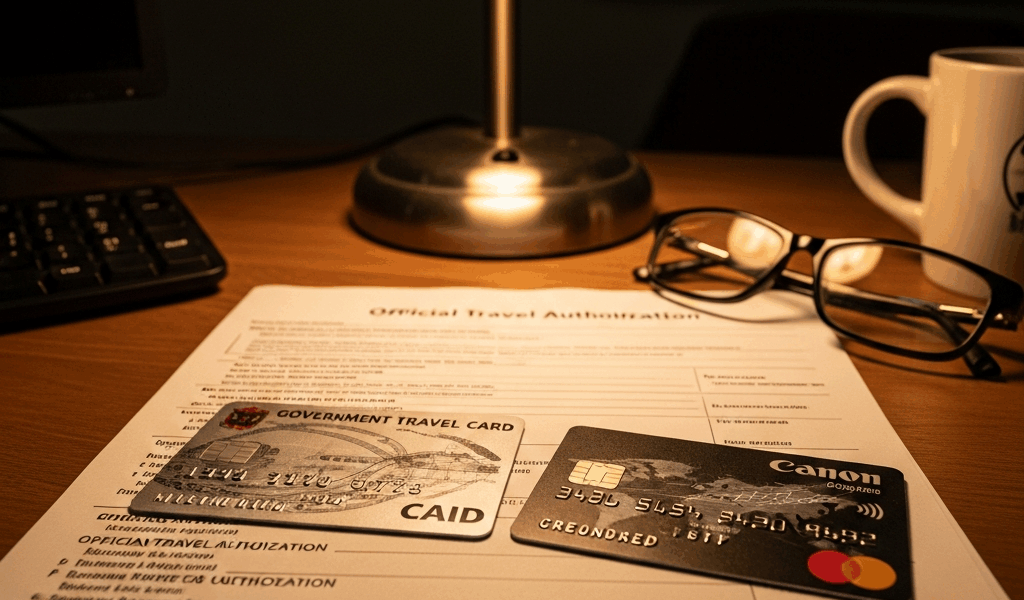
Government Travel Card vs Personal Card for TDY — Which Should You Use?
The government travel card vs personal card TDY question has gotten complicated with all the conflicting advice flying around — especially when you’re standing at a hotel front desk at 11 PM in Fort Worth, your GTC is getting declined, and you have no idea what you’re actually allowed to put on your personal Visa. I’ve been there. Spent a week of TDY to Lackland using the wrong card for the wrong things, then spent two months untangling the voucher afterward. Today, I’ll share everything I wish someone had handed me before my first set of orders.
The Short Answer — GTC Is Required for Most TDY Expenses
The DoD mandate is not subtle. Under the Joint Travel Regulations, the Government Travel Charge Card is mandatory for all official travel expenses — at least when the card is available and the expense is reimbursable. That’s it. Full stop.
But what does “official travel expenses” actually cover? In essence, it’s lodging and commercial transportation. But it’s much more than that. If you’re booking a flight through the Defense Travel System, that charge goes on the GTC. Paying for a hotel at the government rate — say, $98 per night at a Hampton Inn in San Antonio — that’s GTC territory too. Rental cars through an approved vendor? GTC. Airport parking? GTC.
The consequences for ignoring this range from annoying to career-damaging, depending on your command’s culture and how often it happens. At minimum, your finance office can flag the voucher and refuse to reimburse expenses charged to a personal card when the GTC should have been used. Some units want a written explanation. Others let the first offense slide with a counseling statement. Don’t count on the latter.
- Commercial airfare booked through DTS — GTC required
- Hotel lodging at TDY location — GTC required
- Rental car through an approved DTS vendor — GTC required
- Airport shuttle or cab to/from the terminal — GTC required if reimbursable
- Baggage fees on official travel — GTC required
The logic is straightforward: the government wants a paper trail, and the GTC provides it automatically. Every charge feeds into the reconciliation process when you file your travel voucher. Personal card? That clean audit trail disappears. Someone then has to manually verify every single receipt. Nobody wants that job — least of all you.
When You Can Use Your Personal Card
Probably should have opened with this section, honestly. This is what most of you actually came here for.
Meals and incidentals. That’s the big one. Your M&IE per diem gets paid directly to you — not charged to a merchant — so the GTC is irrelevant for meals in most situations. You’re getting a flat daily rate somewhere between $59 and $79 for most CONUS locations under current JTR rates. How you spend it is your business. Pay for lunch at the DFAC with cash. Put dinner at a local restaurant on your Delta SkyMiles Amex. The GTC doesn’t come into play here unless your unit has a specific local policy — and some do, so check.
Non-reimbursable expenses are the other obvious category. Buying a phone charger at the Walgreens near your TDY hotel because you left yours at home? Personal card. Personal laundry beyond what the JTR covers, souvenirs, gym fees at a non-military facility, streaming subscriptions — none of that is reimbursable and none of it belongs on the GTC. Don’t make my mistake of mixing these up early on.
GTC declined situations also justify personal card use — though you need to document this carefully. If your GTC has $500 in available credit and your hotel hold is $600, you may have no choice. Keep every receipt, note the decline in your voucher remarks, and file for reimbursement normally. Finance will process it, but expect questions.
There’s also a category of expenses that are technically reimbursable but fall below the mandatory GTC use threshold. This varies by branch. Check your specific regulation. Don’t assume.
The Points Optimization Strategy
As someone who burned a previous TDY by putting everything on a Chase Sapphire Reserve out of sheer habit, I actually sat down and mapped out what’s legal before my next set of orders. Here’s what I found.
You can absolutely maximize personal card rewards on TDY — legally — by concentrating them on M&IE spending. Fourteen-day TDY at an M&IE rate of $74 per day works out to $1,036 in food and incidental spending you’re free to run through whatever card earns the best return. The Chase Sapphire Preferred earns 3x points on dining. The Amex Gold earns 4x. I’m apparently wired to obsess over this stuff, and the Amex Gold works for me while the Sapphire Reserve never quite justified its $550 annual fee for my spending patterns. On roughly $1,000 in meal spending, 4x earning gets you 4,000 Membership Rewards points — worth somewhere between $40 and $80 depending on how you redeem them. Not life-changing. But it stacks across multiple trips per year.
The GTC earns nothing. Zero. It exists purely as a government financial management tool — not a rewards vehicle. Use it for what it’s required for, full stop. Don’t try to run lodging or flights through your personal card to chase points. The reimbursement risk and the finance headache aren’t worth it.
One more legal optimization worth mentioning: if your TDY location allows you to save money by staying somewhere cheaper than the government rate and you want to use a personal card for a non-DTS booking, talk to your travel approving official first. Some situations allow this. Most don’t. Get it in writing before you check in.
GTC Payment Timeline — Why Late Payments Are Dangerous
This is the section nobody wants to read but everybody needs to. The GTC is not a normal credit card. It does not behave like your personal Visa. The rules are different and the consequences of ignoring them are genuinely serious.
Payment is due 30 days from the statement date. Not 30 days from when you get reimbursed. Not 30 days from when you file your voucher. Thirty days from the statement. This matters enormously when your voucher is sitting in a supervisor’s inbox waiting for approval and your GTC bill is already aging.
Delinquency consequences happen in stages. At 61 days past due, Citibank — the GTC contractor — typically suspends the card. At 126 days, the account goes into salary offset, meaning the debt can be collected directly from your military pay. Your commander gets notified at various thresholds depending on branch policy. That notification is not a casual heads-up. It goes in writing. It generates administrative attention you do not want.
I know someone — a staff sergeant with a genuinely excellent service record — who had two late GTC payments surface during a security clearance review. The payments totaled maybe $340 combined. That was 2019. He kept his clearance, but it added six weeks to his renewal and required a written explanation. Over $340. File your voucher fast. Pay the bill the day your reimbursement hits your account. Set a calendar reminder if you have to. Treat this card like what it is — a government-issued financial instrument attached to your career.
Branch-Specific GTC Rules
The JTR provides the DoD-wide baseline, but each branch has its own implementing instructions — and unit-level commanders have more discretion than most people realize. This is where “it depends” becomes the accurate answer rather than a cop-out. That’s what makes GTC policy so frustrating to us service members trying to just do the right thing.
Air Force
Air Force Instruction 65-114 governs GTC use in the Air Force. The AF generally follows JTR mandatory use requirements closely and has a reputation for more rigorous DTS compliance enforcement than some other branches. Deployed and remote unit commanders may grant waivers for specific expense categories — documented exceptions, not informal understandings. If you’re at a major command like AMC or ACC, expect a tight compliance culture. First, you should verify your specific unit’s local operating instructions — at least if you want to avoid a voucher rejection.
Army
Army Regulation 215-1 and related finance regulations govern Army GTC policy. The Army has a larger proportion of units operating in environments where GTC acceptance is limited — forward operating locations, training areas at remote installations like Fort Irwin — and the exception documentation culture reflects that. Army finance offices at smaller installations sometimes have more flexibility processing personal card reimbursements when GTC use wasn’t practical. Mandatory use policy still applies at the regulation level, though. Don’t assume your S4 or finance NCO can just wave it away.
Navy and Marine Corps
NAVSUP Publication 485 and Marine Corps Order P4650.37 govern their respective GTC policies. The Navy and Marines tend to have the most unit-level variation of any branch — particularly in how commands handle GTC delinquency notification and what counts as an acceptable exception. A ship’s disbursing office handles TDY finance differently than a shore installation finance office. Marines deployed from MEUs often operate under specific travel finance guidance issued per deployment. Know your unit’s specific instruction. Not just the branch-level document. The branch-level document won’t save you when your disbursing clerk pulls up the MEU order.
The universal rule across all branches: when in doubt, use the GTC for anything that looks like an official travel expense, file your voucher quickly, and pay the bill immediately when reimbursement hits your account. The optimization questions — personal card points, expense categorization — are worth thinking through. But they’re secondary to keeping that card current and keeping your finance office happy. So, without further ado, go check your current GTC balance and make sure nothing is sitting unpaid right now. Seriously.




Leave a Reply