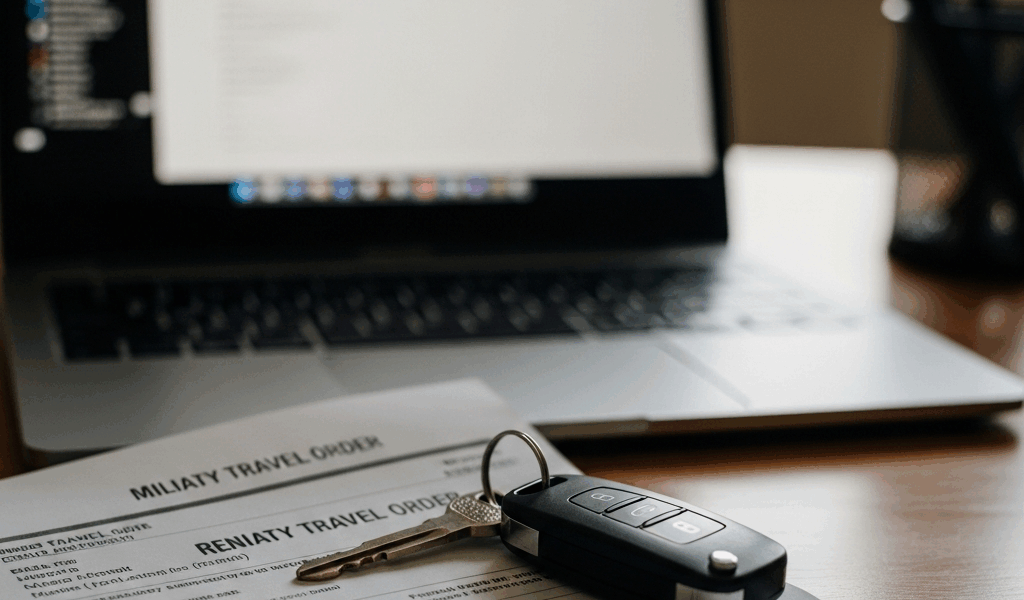
Why Your Orders Being Silent on Rental Cars Is a Problem
TDY rental car approval has gotten complicated with all the conflicting guidance flying around. And when your orders are completely silent on the subject? That’s where things get expensive fast. I showed up at Fort Bragg for a two-week assignment — this was late October, 2019 — drove straight to the airport, grabbed a compact sedan from Avis, and figured my chain of command would sort out the paperwork afterward. They didn’t. Finance flagged the claim 23 days later. That was a fun email chain.
Here’s what the Joint Travel Regulations — the JTR, for those of us who’ve had to read the thing cover to cover — actually say. Rental car use must be mission-essential. That’s the threshold. But there’s a second condition most people miss: you need either pre-authorization written into your orders, or explicit approval from your authorizing official before you swipe the government card. Not after. Before. If your orders don’t mention rental cars and you just decide you need one, reimbursement can be denied outright. Full stop.
I’ve watched this happen to sharp, organized people. Orders arrive. They read them twice. Nothing about ground transportation beyond the standard mileage language. Duty site is 45 minutes from the airport. No shuttle. No motor pool. They rent anyway — because obviously they need to get to work — and then spend two months in an email thread with finance trying to justify $600 nobody technically authorized. Don’t make my mistake, and don’t make theirs either.
The stakes are real. You’ve already spent the money. Your per diem clock ran while you were stuck in that rental office at baggage claim. You’re in a new location, trying to focus on the actual mission, and instead you’re drafting memos explaining a decision you made at 11 p.m. after a six-hour flight.
Check These Two Things Before You Call Your AO
Before you pick up the phone, do some homework. Seriously. I learned this the hard way after the Fort Bragg situation.
First, log into your DTS authorization — Defense Travel System, for anyone somehow reading this without context — and look for a line item specifically for rental car. Sometimes it’s already there. Some authorizing officials build rental car authorization into the standard framework without calling it out in the narrative section of the orders. I once found a $65-per-day ground transportation line item I’d completely missed because I was skimming the PDF instead of reading the line-item breakdown. Embarrassing, but useful to know.
Second, read your orders again — slowly — and look for blanket transportation language. Not every set of orders says “rental car” explicitly. Some say “transportation will be provided by the government,” which is vague enough to cause problems either way. Others include phrases like “necessary ground transportation” or “local travel as required by the mission.” That second phrase is actually useful leverage. It’s not a rental car authorization on its own, but it signals the AO was already thinking about ground transportation when they cut the orders.
Bring this documentation to the conversation. Show up knowing what’s already in the authorization framework. Your AO will appreciate that you’re asking for clarification on something specific — not just calling with a hand out.
How to Get Your AO to Amend the Authorization in DTS
Call them. Email is too slow and too easy to ignore. Call your authorizing official directly, or go through your direct supervisor to get on their calendar the same day if possible.
Here’s what to actually say. Be specific — not general. “My duty site is 47 miles from the airport. No government vehicle is available through the motor pool. The contract hotel on Ramsey Street has no shuttle service. I need a rental car to report on time and safely.” That’s the version that works. “I kind of need a car” is the version that doesn’t.
Have your documentation ready before the call. Know the exact distance. Screenshot the hotel location and the duty site on Google Maps. If there’s no shuttle and no motor pool option, say so explicitly. If a medical reason prevents you from relying on rideshare — say, a documented mobility issue — mention that too. The AO needs to see mission necessity, not personal convenience.
Once you’ve made the case, ask the AO to amend your DTS authorization before you travel. That’s the key move here. An amendment adds a rental car line item to the authorization — it’s traceable, it’s documented, and finance sees it from day one. No ambiguity, no gray area.
If the AO can’t amend in time, get written email approval before you book. Not a text. Not a verbal thumbs-up over coffee. An actual email — something with a subject line like “Authorization for TDY Rental Car — [Your Name], TDY Period [Dates].” Screenshot it. Save it in two places. Forward it to your personal email if your government account has storage limits.
Verbal approval means nothing to finance. I’ve personally watched a claim get rejected because the only evidence was “my commander said yes.” It wasn’t on the books. Write it down — every single time — or don’t count on it.
What to Do If You Already Rented Without Authorization
Probably should have opened with this section, honestly, because it’s the situation most people are actually in when they find this article.
You’re back. The rental was necessary. The orders said nothing. Nobody approved it beforehand. You need reimbursement. This is harder — not impossible, but harder.
Contact your AO immediately. Within one week of return, ideally sooner. Ask them to pursue a constructed travel exception to policy through the finance office. Be honest about the timeline. Be honest about why you rented. Make the case that the mission couldn’t have moved forward without ground transportation.
You’ll need to write a justification memo. One page — maybe two if the situation was complicated. State the facts: duty location and distance from the airport, absence of shuttle service or government vehicle, why the rental was the only workable option, and the total cost. Mine ran $312 for four days at $78/day through Enterprise. End the memo with a direct request for finance to approve an exception based on mission necessity.
Tone matters more than most people realize. Don’t sound defensive. Don’t over-apologize. Sound like someone who made a professional judgment call in the field — because you did — and now needs the documentation to match the decision. Finance reviews these. They might approve it. They might not. They might ask for more. The longer you wait, the less goodwill you have in the room. Submit within the week, not in three months.
Rental Car Classes and What JTR Actually Reimburses
Economy class is the standard. Full stop. If rental car use is authorized, you’re reimbursed up to the economy rate — typically a compact or mid-size sedan, whatever comes in under that daily cap.
Upgrades aren’t covered unless a documented medical reason prevents you from using a compact car, or the mission itself requires a larger vehicle — transporting equipment, moving multiple personnel, that kind of thing. “The mid-size was more comfortable” doesn’t qualify. I’m apparently six-foot-three and a Toyota Corolla works fine for me, so the standard really does hold in most cases.
One more thing — and this one costs people real money. Decline the rental company’s extra insurance at the counter. The government self-insures. You’re covered under the rental agreement’s liability terms and the federal employee liability program. Buying the Hertz collision damage waiver at $17.99 a day is money you’ve already spent and money that won’t get reimbursed. So, without further ado: skip it every time.



Leave a Reply