Why Hotels Charge Tax on Government Travel Anyway
Government lodging tax exemptions have gotten complicated with all the misinformation flying around — and the silence from people who should be explaining this stuff upfront.
As someone who has stood at enough hotel front desks with travel orders in hand, I learned everything there is to know about this particular headache. Today, I will share it all with you.
Here’s the core problem nobody warns you about. The exemption is real. It exists. But it isn’t automatic — not even close. Hotels have to actively opt into honoring it. They need trained staff, the right forms on hand, and proper registration with their state. Most properties have none of those three things.
Two failure points show up constantly. Front desk clerks have never seen the certificate you’re presenting, or the hotel isn’t registered as an exempt vendor, meaning their accounting system physically won’t remove the tax at checkout. Neither failure is your fault. Both become your problem at 11pm when you’re exhausted and just want the key.
Frustrated by a doubled bill after returning from TDY, I spent three weeks calling hotel billing departments and state revenue offices trying to understand why one Hampton Inn let me skip tax entirely and the property two miles away wouldn’t budge. The answer is messier than you’d expect. Some states require direct government payment or a GTC. Some want a state-specific certificate. Some exempt federal employees but draw a hard line at contractors or reservists. Hotels operating across multiple states often just give up entirely and charge everyone the same way.
What You Need Before You Check In
Bring these. All of them. Before you arrive.
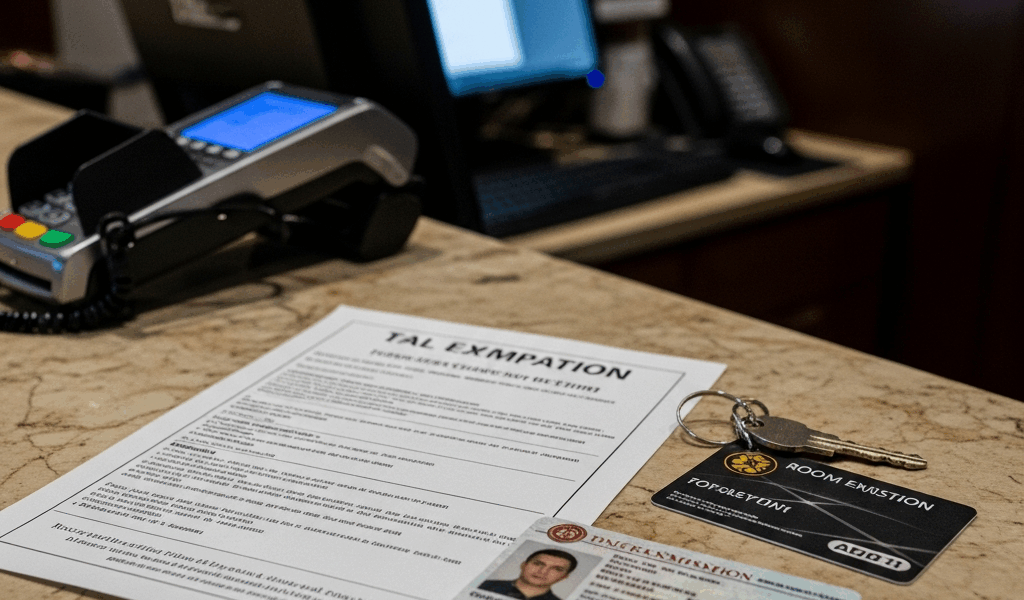
- Your government travel orders — printed or pulled up on your phone, with the TDY location and exact dates visible. Don’t make them hunt for it.
- Government-issued ID — military ID, federal employee credential, or equivalent. The hotel needs confirmation you’re actually authorized, not just someone who found a form online.
- State lodging tax exemption certificate — this is where people stumble badly. Find it through the GSA SmartPay tax information page for your specific destination state, or call that state’s department of revenue directly. Do not assume the standard GSA form works everywhere. It doesn’t. California alone uses its own separate certificate.
- Your GTC card if applicable — many states will only grant the exemption when payment runs through a government card. Some exempt any federal travel regardless of payment method; others are rigid about it. Check before you book, not during checkout.
Probably should have opened with this section, honestly. But here’s the part most guides skip entirely: some states don’t care what certificate you’re waving around. They want proof of payment method. If you’re using personal funds expecting reimbursement later, and your destination state requires GTC payment, you won’t qualify — full stop. Check the GSA tax page before the trip. Not after.
When you’re booking inside DTS, verify the property’s exemption status right there in the system. Some properties are flagged as tax-exempt vendors. Others aren’t. That thirty-second check saves a genuinely miserable argument at the front desk later.
What to Say When the Hotel Pushes Back
Calm works better than correct in these moments. So, without further ado, let’s dive in.
Scenario One — They Don’t Have the Form
“I understand. Here’s a copy of the state lodging tax exemption certificate — I printed it before arriving. I also have my travel orders and government ID. The state permits me to provide these directly when the property doesn’t have the form on file. Could you call your manager or your revenue department to confirm your property’s exemption status?”
Keep your tone level. Don’t demand. Ask them to verify. If they still say no, escalate: “I’d like to speak with the manager on duty. This specifically involves whether your property participates in the state tax exemption program.”
Scenario Two — They Say the Property Isn’t Exempt
“Could you check your system for exempt vendor status? Properties are sometimes registered but the front desk hasn’t been notified. If it’s not showing up, I’d appreciate the name and direct number for your billing or accounting department so I can verify this before I check out.”
That’s what makes this approach effective for travelers — it shifts the entire conversation from “does this person have the right paperwork” to “is your company actually set up for this.” It also creates a paper trail. If they hand over the number, call accounting before you leave town. One five-minute call can sometimes flip the entire situation.
Scenario Three — Manager Is Unavailable or Still Says No
This one stings. But here’s the fallback:
“I’d like to note on my folio that I presented a valid government travel exemption certificate and the property declined to honor it. Could you add that to the comments field so there’s a record of the dispute?”
Then pay. Don’t get stranded fighting a billing system at midnight. You’ll fix it after travel — and you can.
Before you walk away from the desk, ask for an itemized receipt. Specifically request the line showing the tax charge as a separate item. They’ll ask why. Tell them it’s for your travel voucher. Most will print it without a second question.
If You Already Got Charged Tax, Here Is What to Do
Getting hit with tax you shouldn’t owe is aggravating. It’s also fixable. Don’t absorb the cost and move on.
Send a written request — email, not a phone call — to the hotel’s billing or finance department within two weeks of checkout. Include your confirmation number, the stay dates, and scanned copies of your government travel orders and ID. State it plainly: “Your property charged lodging tax on a federal government traveler eligible for exemption under [state name] law. I am requesting a refund of $[amount] charged on [date].”
Send it with a read receipt enabled. Save every response — including no response.
In DTS, claim your full lodging reimbursement as normal. Don’t skip this. In the remarks or voucher comments field, document the overcharge separately: “Hotel charged $XX in lodging tax despite presentation of valid exemption certificate. Dispute submitted to billing department on [date]. Reference: [confirmation number].”
I’m apparently meticulous about confirmation numbers and saving email threads — and that habit has worked for me while just relying on verbal disputes never has. Don’t make my mistake.
Some states actually allow you to request a refund directly from the state revenue department when a hotel refuses to cooperate. Worth checking your state’s rules specifically. If the hotel goes silent past 30 days, escalate to your finance office.
States Where This Gets Complicated
Not every state gives blanket exemptions to every federal traveler. Not even close.
But what is a lodging tax exemption, exactly? In essence, it’s a state-level rule waiving occupancy tax for qualifying government travel. But it’s much more than that — because qualifying looks completely different depending on which state you’re standing in.
Some states restrict exemptions to active-duty military and direct federal employees. Contractors, reservists, and family members on official orders often don’t qualify — even with perfect documentation. Some states require GTC payment specifically and won’t honor cash advances or personal reimbursement arrangements. Some want a state-issued form and won’t accept the GSA version as a substitute.
Texas, Florida, and California — three of the most traveled states in the federal system — each run by different rules. Texas exempts federal employees under specific conditions that depend heavily on payment method. Florida takes a stricter reading of what constitutes qualifying federal travel. California created its own exemption certificate, Form BOE-261-G, entirely separate from the GSA version — and front desk staff in California hotels often haven’t seen either one.
Before departure, verify your exact traveler status and your destination state’s current rules on the GSA SmartPay tax information page. That’s five minutes of research. It saves hours of friction at check-in and days of back-and-forth with hotel billing afterward.
The exemption is real. It just only works when you walk in prepared to enforce it yourself.

Leave a Reply