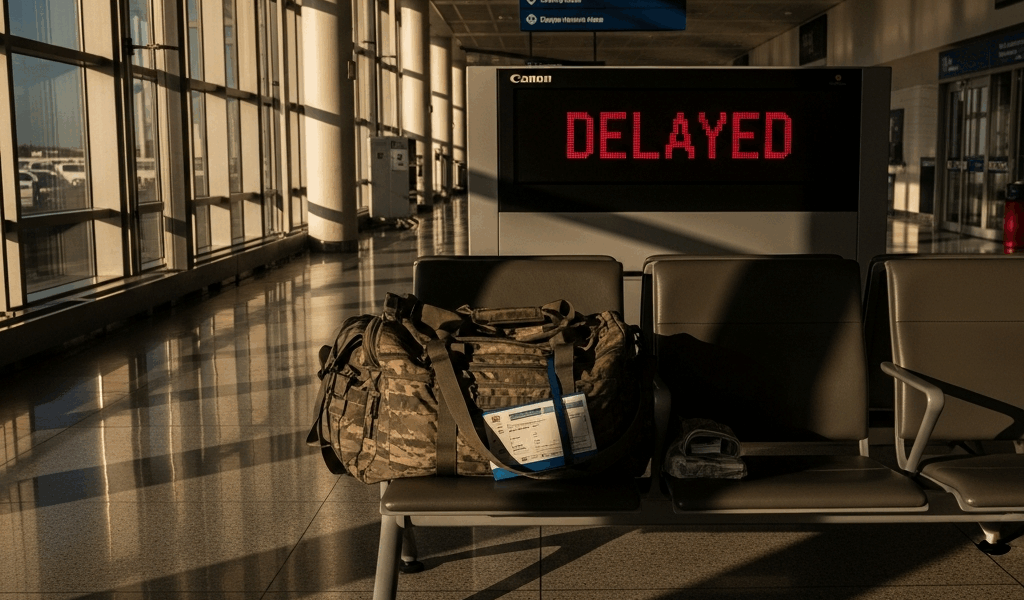
Why the Cause of Your Delay Actually Matters
TDY return travel has gotten complicated with all the conflicting guidance flying around. I’ve watched plenty of people come back from temporary duty assignments expecting smooth sailing — only to find their flight cancelled, weather rolling in, or their commander tacking on two more weeks. What you can actually claim for those extra days? It depends entirely on one thing: who caused the delay.
The Joint Travel Regulations — the JTR — breaks this into three buckets. Knowing which one applies to you changes everything.
A government-directed delay is exactly what it sounds like. Your command or a higher authority extended your TDY or blocked your departure. Mission extension. Force protection. One more week of training the squadron couldn’t do without you. That’s on the government, and reimbursement flows accordingly. A common carrier delay means the airline cancelled the flight, mechanical failure grounded the aircraft, weather closed the airport. Things nobody at the traveler level controlled. Those situations trigger a specific set of allowances under JTR Chapter 2, Part A.
Personal choice delays are the killers. You stayed an extra day to see friends. You missed your flight and booked another one. You liked the hotel and extended lodging. That’s your responsibility — and finance will treat it that way.
Then there’s the gray area. Your orders say depart on Day 10, but something outside your control kept you grounded. No amended orders ever materialized. Your supervisor said stay, but nothing official got documented. That’s where a memorandum for record becomes your best friend. I’ll get into that below.
What You Can Claim for Extra Lodging and Meals
Lodging during an approved delay is straightforward — in theory. You get the per diem rate for that locality, same as your original TDY authorization. Orders sent you to Atlanta at $145 per night, delay kept you there four extra days, you claim $145 per night for those four days. DTS processes it without argument when your authorization actually covers the dates.
The real problem arrives when your authorization doesn’t cover those dates — or when actual lodging costs exceed the authorized rate. Downtown Atlanta during convention week can run $189 a night. Your per diem cap is $145. You have two options: absorb the difference yourself, or document why the higher rate was unavoidable.
JTR allows an exception to the lodging rate when the delay was government-directed and alternatives at or below per diem were genuinely unavailable. Not “I didn’t feel like calling other hotels.” You called. They were fully booked or quoted rates above the cap. A hotel confirmation email showing $189 with a notation — “all standard rooms sold out due to convention” — becomes your documentation. Screenshot it. Print it. Attach it to your voucher. That’s the actual evidence finance needs.
Meals complicate things further. If the airline handed you a voucher during the delay, that reduces your meal per diem claim. You don’t collect full per diem plus the voucher — you claim partial per diem only for meals you paid for out of pocket. Same logic applies when your hotel offered complimentary breakfast. Can’t claim breakfast per diem if breakfast was provided. Keep every receipt and note which meals were covered by whom.
I submitted a voucher once claiming full meal per diem on a day when the command had catered lunch and the airport lounge had covered dinner. Finance rejected it. I resubmitted. Cost me three weeks of processing time. Don’t make my mistake.
How to Update Your DTS Authorization Before You Get Home
Probably should have opened with this section, honestly. The best time to fix an authorization that doesn’t cover your delayed return is while you’re still on the road. Not when you land. Not when you’re sitting at your desk two weeks later drafting a voucher and realizing the dates don’t match.
For government-directed or mission-related delays, your supervisor or command must request an authorization amendment in DTS. You don’t initiate this yourself. You tell them: “Sir — or Ma’am — I’ve been extended through [date]. Can you amend my TDY authorization?” They log into DTS, pull up your authorization, click “Amend,” extend the return date, and resubmit to your authorizing official — usually your squadron commander or department chief.
Request the amendment before your original return date when possible. JTR gives you some room, but the closer you cut it to your authorization end date, the more likely something falls through. Some commands require amendment requests within 48 hours of learning about an extension. Others are looser about it. Ask your finance officer or travel coordinator what your unit expects — before you’re stuck somewhere without coverage.
For common carrier delays, the amendment process works similarly, but the documentation shifts. You need the flight cancellation notice, a weather alert, or airline communication explaining why the flight didn’t operate. Your supervisor still requests the amendment — but now it’s supported by carrier documentation rather than a mission extension order.
Stuck in a hotel with no amended authorization yet? DTS lets you drop a temporary note in the remarks field: “TDY extended by [command name] on [date]. Amended authorization pending.” That’s not a substitute for the actual amendment — but it flags the voucher so finance knows you’re aware of the gap and actively working it.
When Your Orders Do Not Cover the Extra Days
Some delays slip through without amended orders. Your commander told you to stay. You stayed. You came home on Day 14. Your orders say Day 10. Now what?
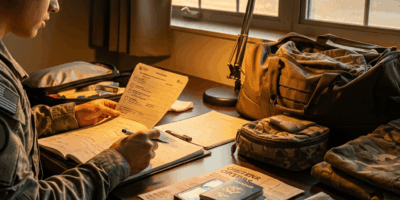
A memorandum for record is your tool. One page. Official military memo format — TO:, FROM:, DATE:, SUBJECT:. Three or four paragraphs, not ten. Something like: “SUBJECT: MFR — TDY Extension and Delayed Return, [Your Name], [Dates].” In the body, state the facts plainly. Your original return date. What extended your stay — weather, mission requirement, carrier issue. Who directed you to remain. Why an amended authorization wasn’t obtained before you returned. Name the people who told you to stay and include their titles.
Your supervisor or commander signs this MFR. Not you. A commander’s signature carries weight in finance reviews in a way that a self-signed statement simply doesn’t. Attach it to your voucher and note in remarks: “See attached MFR explaining delay and extension, dated [date].”
Submitting a voucher that shows date mismatches without any documentation is a gamble — and usually a losing one. Finance will catch the discrepancy and either kick it back for correction or deny the extra days outright. An MFR doesn’t guarantee approval, but it gives finance the explanation that stops an automatic rejection.
Common Voucher Errors After a Delayed Return and How to Fix Them
Four errors show up on delayed-return vouchers more than anything else.
Date Mismatches. Authorization ends on Day 10. Actual return was Day 14. DTS flags it automatically. Fix: update your authorization end date before submitting the voucher, or attach documentation — amended orders or an MFR — explaining the gap. Finance needs that explanation in writing before they’ll process a single extra day of per diem.
Lodging Over Rate Without Justification. You claim $189 nightly when the authorized rate is $145. DTS may let you enter that number. Voucher review won’t let it pass. Fix: attach hotel confirmation showing standard rooms were unavailable at or below the authorized rate. Writing “unavailable at authorized rate” in the remarks field is not enough — finance needs the actual evidence. A confirmation email with dates, rates, and a sold-out notation does the job.
Missing Receipts for Extended Meals. You claim meal per diem for four extra days, but anything above roughly $50 per day typically requires backup documentation — though the exact threshold depends on your command. Fix: scan and upload every receipt. No receipt? Submit a written statement accounting for each meal in amounts below the documentation threshold.
Incomplete Carrier Documentation. You claim a delayed return due to flight cancellation but DTS shows nothing backing that up. Finance assumes the delay was voluntary. Fix: before you submit, attach a screenshot of the flight status showing the cancellation — or a letter from the airline. Email confirmations from carriers work. A text message screenshot, honestly, also works in most cases — just include it.
A corrected voucher typically processes within 10 to 15 business days after resubmission. If yours sits past 20 days without movement, contact your authorizing official or finance directly to confirm they received it. An escalation to your AO usually triggers a review that speeds things up — sometimes significantly.



Leave a Reply